
Van versus Banana
our month in the artworld

We spun the wheel, rolled the die, but the little ball didn’t exactly land in the little slot we’d hoped it would.
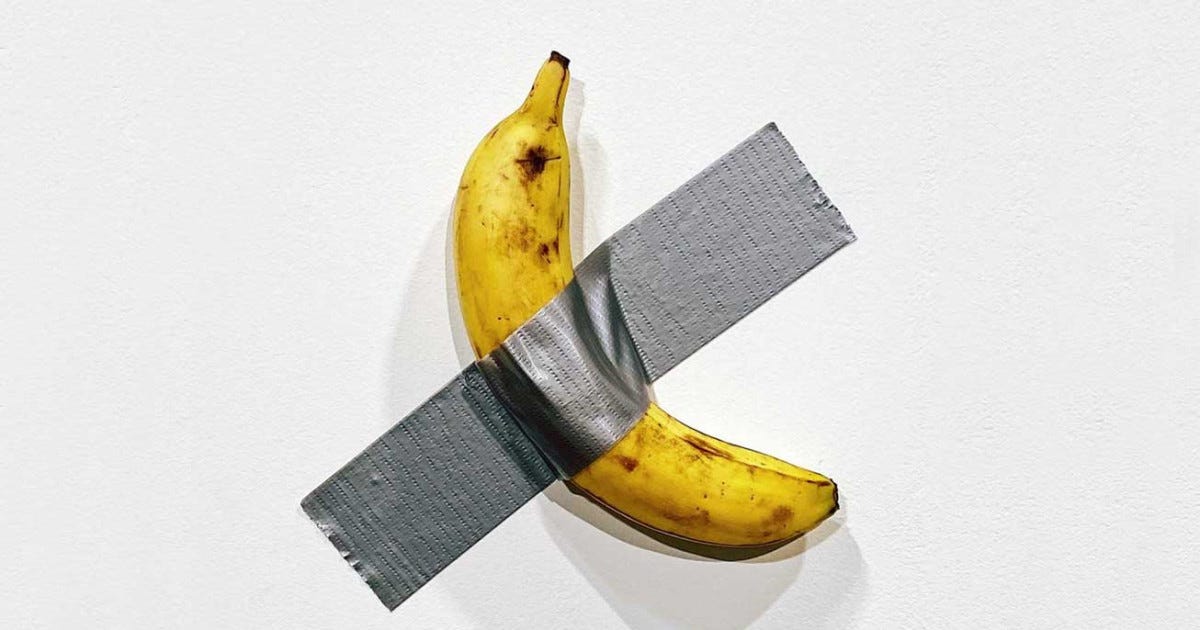
A room full of serious-looking people in fine clothing, paddles raised, phones pressed to ears as offers come in from far-off buyers. The price climbs and climbs, as if it might never stop. The hammer finally comes down significantly north of $6 million. The lot is a banana, duct-taped to a wall.
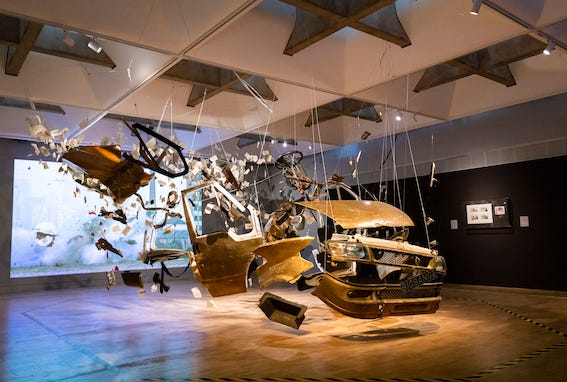
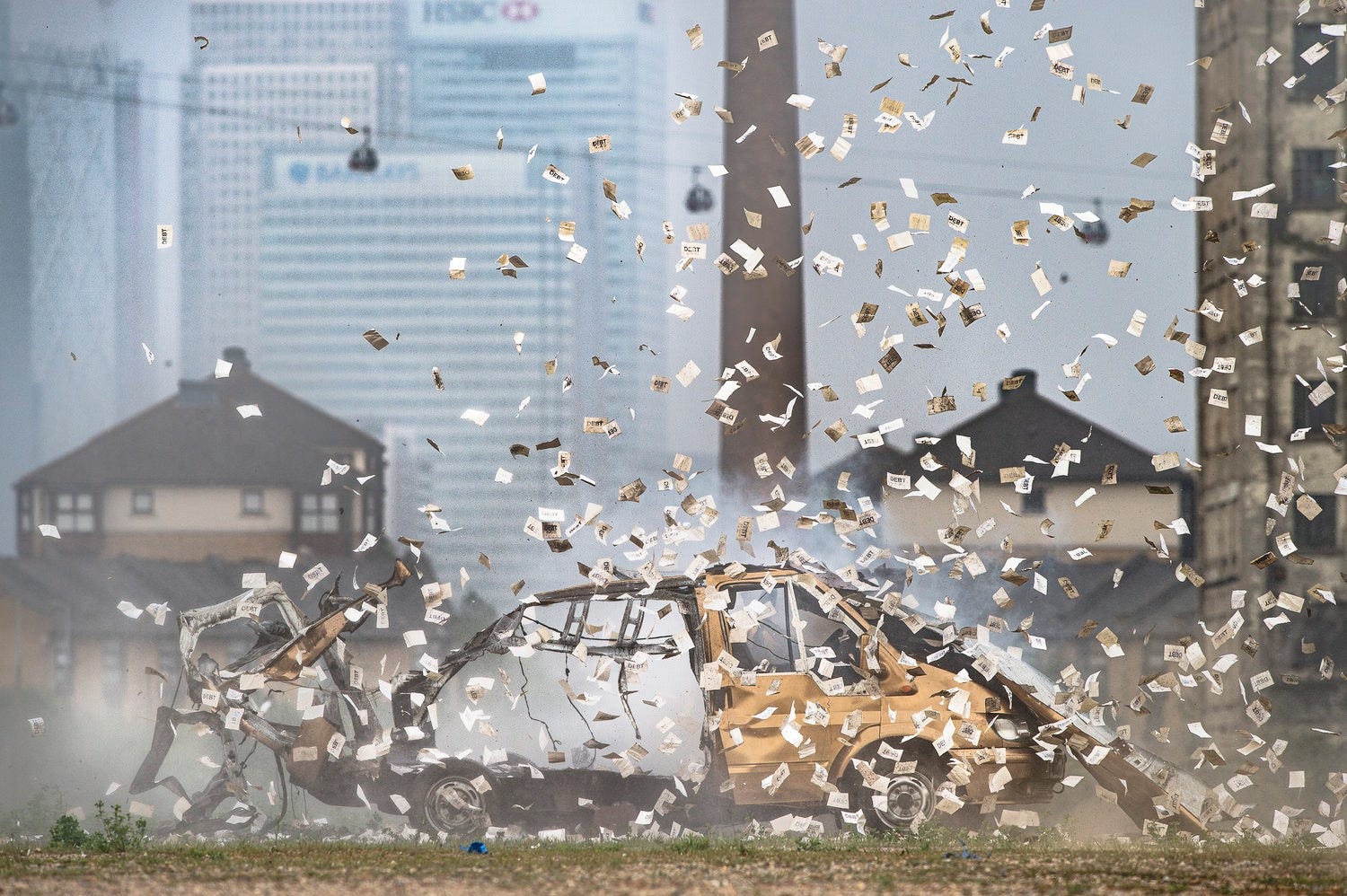
Meanwhile in a parallel universe, we’ve just held our own auction for a perfectly good exploded van that we filled with high-interest debt and which once hung at the Fitzwilliam in Cambridge. We couldn’t persuade a single museum to take it (yet), nor anyone to call in from China or the US even with a measly £100,000.
For the last month, Hilary and I played within the system of rules — the class-based art world, where the gates are kept mysteriously by a group of establishment overlords. They decide who gets to be in that world, how it works, what should happen, what shouldn’t, and a million shades in between.
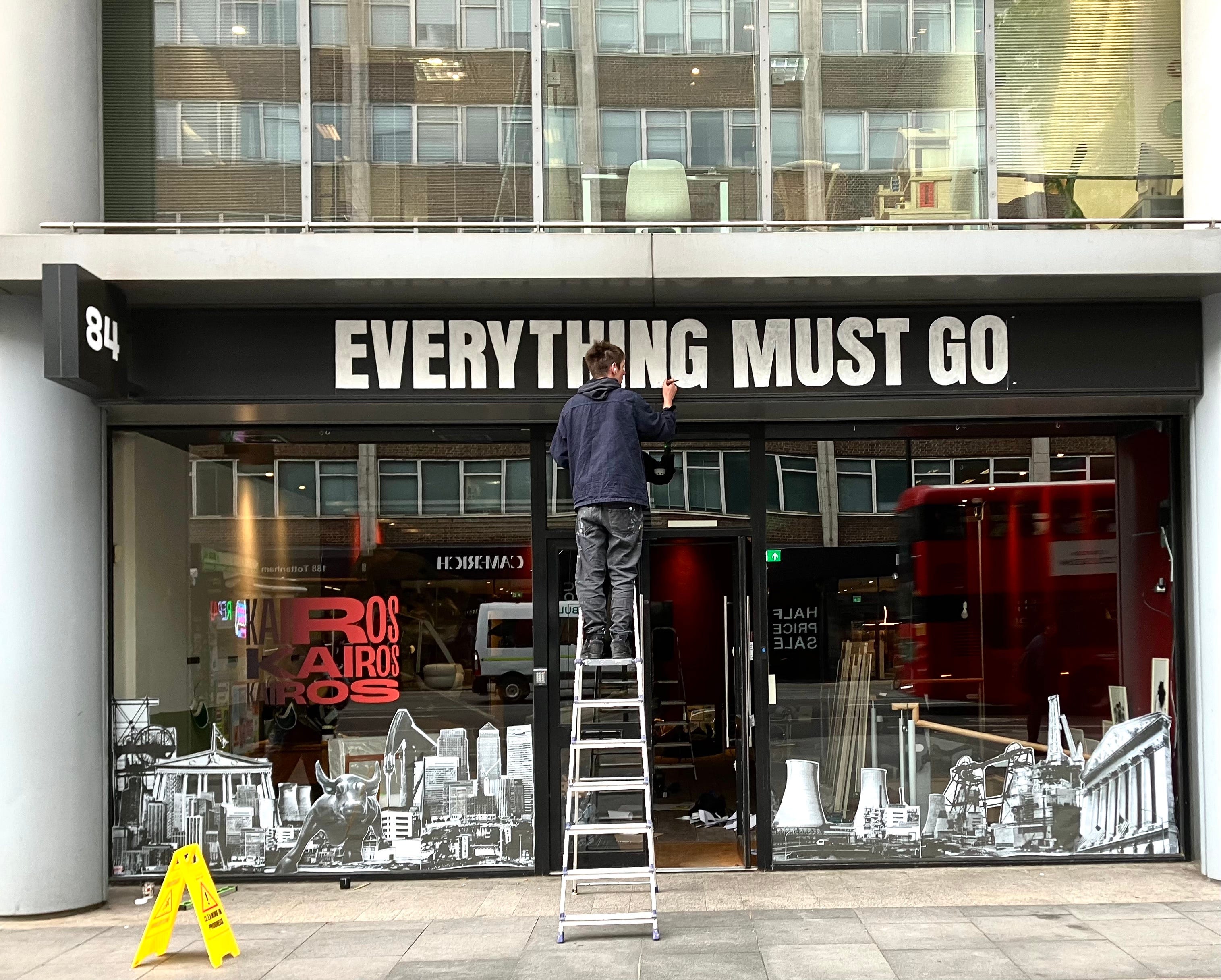
We spent a month emailing the higher-ups — trying to get them to chat with us, asking if they would come to our exhibition at Kairos, would they take a blown-up van into their museums, would they help us use art to fuel our independent filmmaking.
The results of our experiments were partially captured on camera, although we haven’t yet cut the footage. I explained what we were doing to a friend I bumped into — he’d stumbled on our show by accident a few days earlier — and asked if he thought it might come off, and that our blown-up van might get collected by the V&A or another major museum within the 2-3 week window we had. He said for that to happen it would have to be a work of “cultural importance.” His reply sliced through my hopes, implying that our work almost certainly was not important enough for this to happen. “Cultural importance” — the words were delivered with so much certainty, as if this could be tested in a laboratory.
This was the first hint that our auction might not meet with success. I thought to myself that the work we do is culturally important. Blowing up a van full of debt outside the towers of finance in the City of London was deemed culturally important enough at the time to elicit a desperate attempt by the City of London to close us down. It was covered in the Guardian, hung at the Fitzwilliam in Cambridge, and was the climax of our BFI-backed film Bank Job. But the truth is that none of these things really matter much when it comes to the sales price at an auction house. Thinking about it, I realised we actually didn’t make the work to be “culturally important” in the world of auction houses, where the meaning of a work takes a secondary seat to its commercial value. Big Bang 2, as we call it, was made more with the view of questioning power, and creating an image potent enough to puncture “the spectacle” — the pervasive idea of the infinite and never-ending power of capitalism, that “it’s easier to imagine the end of the world than it is the end of capitalism,” as Mark Fisher put it.
But my friend’s words hung in the back of my mind as I travelled down to Kairos with our collaborator Natalie to make a short film about the show. We know there are thousands of people who feel the work we do has significance and value — about six thousand of them paid money into our memberships and crowdfunders to help us create Power Station. But the feeling was dawning on us that there’s an important set of people who are not only uninterested in it, but may actively be trying to shut it down. And they’re the ones who hold the keys to its art market value.
A week or two later, at the show itself, artist Gavin Turk became our auctioneer, and I filmed an interview with him in which he told me that although we felt we were behaving very reasonably and rationally, what we had done was far from straightforward from an art world perspective. Artists never hold their own auctions. They never ring up museums to ask them to take their work. You can’t just email the former director of the Tate and chat to them (we had anyway). You have to wait for recommendations. But here we were anyway — doing all the things we’re not really allowed to do. Asking the art world whether they believed we should exist or not (so far it seemed they didn’t), and ideally asking a representative of that world to validate our work as art. In all these activities we were breaching the hierarchical etiquette of the art world: speak when you’re spoken to, create art when funded properly, auction only when chosen. Wait for your stock to go up. Cultivate an aura of nonchalant mystery.
Those are at least some of the rules of the blue-chip art world. Here are a few more: art is a commodity, and if you’re not a blue chip already, you cannot become one merely by asking the people in charge to deem it so. You cannot become a blue chip by blowing stuff up, turning your street into a Power Station, or holding your own auction. You cannot become a blue chip until they say you are a blue chip — and if they think you want to be blue chip, then you definitely cannot be a blue chip, because the status comes from them and only them.
I began to fantasise about a banana heist. If I were to visit my local greengrocer and buy one, then break into Sotheby’s and steal the original $6 million banana, swap it out — would I now effectively have a $6 million artwork? If so, could I argue that the theft itself was actually a performance, and that really I ought now to be allowed into the art world as a famous performance artist? Or could I find a fence to sell my banana for me, and perhaps retain a fraction of its value? That way I might be able to pay off the bondholders who helped us finish our most recent film, and be in a financial position to develop our new project. I know this sounds bananas, but it’s all worth thinking through.
All absurdity aside, the situation we’re in is the product of a way of seeing art that’s relatively recent. In Artpolitik: Social Anarchist Aesthetics in an Age of Fragmentation, Neala Schleuning traces how art and ethics were once completely intertwined, and how the industrial revolution pulled them apart. She writes that during the rise of capitalism, “art was quickly appropriated and put in service to the capitalist economy. It was de-mythologized and stripped of meaning.”
Before that pivot, art had a social task. Schleuning’s example: in medieval Russia, icons were carried into battle to ensure victory. An icon wasn’t just a picture of a saint. It carried the hopes, prayers, and political will of a whole community — held aloft at the front of an army shouting “this is what we believe, this is who we are.” Art was a branch of ethics, and a tool of collective action.
The industrial revolution detached art from this older function. To serve unbridled production and growth, art was reframed: the artist as romantic spirit, living a rarefied poetic life, not dealing with the concerns or the drudgery the rest of us are forced to navigate. The unwritten rule of the era — if you want to be celebrated, look away from reality. Don’t be political. Make work that glorifies nature or beauty, but not work that asks difficult questions or makes the moneyed classes uncomfortable.
But Schleuning’s book traces a lineage of twentieth-century artists who refused the deal. Dada. Surrealism. The Situationists. In different ways, all of these movements tried to reveal the structures of power and enchantment — and all were punished for it, having to find alternative ways to show their work and find patrons. They “lost” in market terms; many of the artists faded away or retired. But their primary value and legacy was in the refusal to collaborate.
So it turns out it isn’t really art rejecting us. It’s a particular 200-year-old industrial-era construction of art rejecting us. The longer history of art — art as ethics, art as community, art as intervention — is exactly what Hilary and I are doing. We’re not outsiders to art; we’re returning to its older, more dignified function.
Imagine there’s a philosophical war raging inside art, about what art can and should do and what it can be. On one side, theorists like Schleuning, like Berger, perhaps even David Graeber, proposing that art has a social and community function — that it’s about examining the world, seeing power structures, reimagining futures, art as a revolutionary force. And on the other side, the institutional art world that gestures left politically but answers to capital, and would rather not look too closely at the contradiction. Sure, let’s look at the excess. Let’s look at the absurdity of what we’ve created — let’s auction a banana and eat it, isn’t life funny (particularly if you’re a billionaire). But what we should not do is buy art that seeks to be revolutionary, or art that wants to fundamentally challenge or undermine the power systems.
Although in some ways, Cattelan’s banana is itself sending up the value system in which the banana operates. So perhaps it isn’t Van versus Banana after all. Perhaps Van and Banana are travelling down the same road.
But I keep coming back to the feeling that we just experienced a three-week war — a war raging in my Instagram feed, in the newspapers and on the YouTubes I watch. In the establishment art world we tried to penetrate for those three weeks last month, Leonard Cohen sums it up best: “Everyone knows the war is over, everyone knows the good guys lost.” Or maybe it’s more like some of the good guys lost and some of them won — in market terms. Perhaps it’s just a bit more of a casino than we want to admit. That’s annoying, because there’s no clarity, no theory other than chance that can explain it.
On Hilary’s bedside table is a book I bought her called Art is Magic by Jeremy Deller. Deller describes himself before he was famous — broke, obscure, just out of the London College of Printing — applying on a whim to an Artangel open call. The piece he proposed was a recreation of the Battle of Orgreave. It won him the Turner Prize. The lesson he draws from his own career: art is magic — partly chance, partly mystery, partly knowing when to roll the dice.
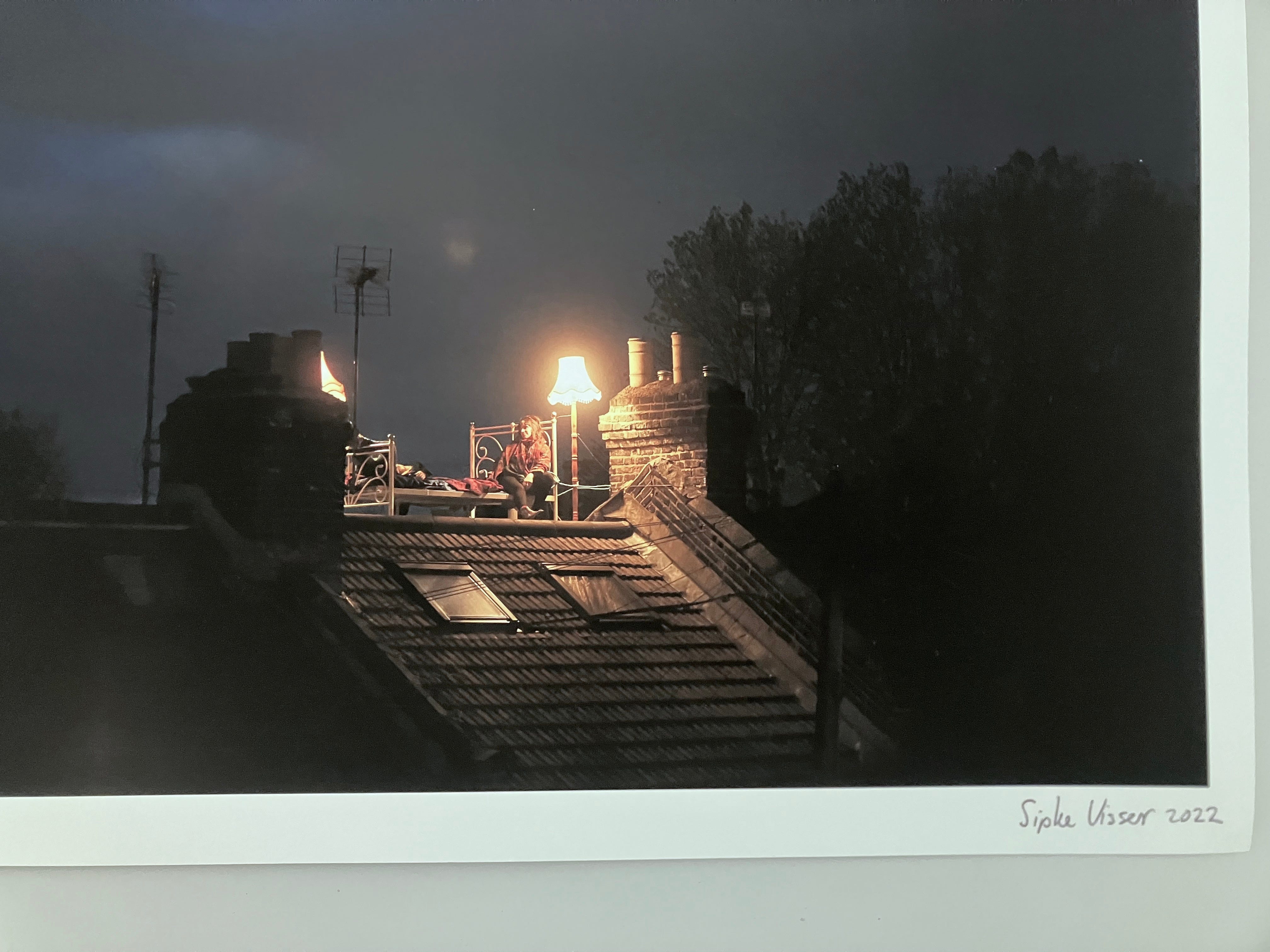
The message of everything being pure chance, and the odds being stacked against you (along with disdain for the overtly political) was repeated by Max Haiven at an in-person talk he gave at Kairos, sitting on a replica of the bed we’d slept on for 23 nights to raise the initial £100,000 to add solar to our street. He told me and a few other assembled guests that the art world likes shocks, but very gentle ones, and not to be too challenged by questions or observations about capitalism. Indeed, one could argue that the upper echelons of the art world exist to do just the opposite — to provide an escape from the problems and realities of capitalism, and to affirm the collector in their choices of art pieces as a rather clever, successful and tasteful player in the world. Art as a thing that compliments them for their choice and who they are as a human being. And, very importantly, art as a store of value, ideally as an asset that should appreciate. The gambling-on-the-future idea creeps in again. Haiven argued that there’s an unwritten agreement between all players in the art world of what has value and what doesn’t — “a conspiracy of belief.” Which is what makes it possible for Maurizio Cattelan to duct-tape a banana to the wall of Sotheby’s — he called the work Comedian — and then sell that banana for $6.24 million. The buyer was Justin Sun, a crypto billionaire. He then ate it.
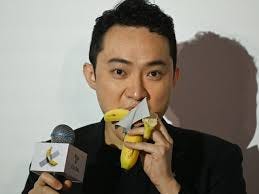
In one of my emails during the auction, I joked that if Cattelan could sell a banana for $6.24 million, then we should be able to sell a perfectly good blown-up van for £100,000.
When I asked Haiven for his advice on how we go from being valued at £2,500 — which was roughly where the online auction was at that moment — to £250,000, the value I had hoped we would achieve before the auction ended, he told me he thought it would never be possible. That the system of stars at the top of the art world is made possible only by having tens of thousands underneath, and that the entire illusion of value depends on the very real lived experience of the struggling masses below. Ourselves apparently included.
Haiven has hit on something important. The concept of the struggling masses creating a triangle that upholds those at the very top is the basic Marxist understanding of our class-ridden social and economic systems, and if you snapshot any industry, it probably looks much the same. But on his conclusion that we’re effectively stuck within the pyramid — that the structure itself is set in stone, an immovable object — I disagree. First, when you look at the history of art, you see that many movements that start out defying the capitalist system end up getting absorbed into it. Once absorbed, the movement loses its edge and point, and in so doing, the way is perversely free for it to become more valuable to the art world itself. I reckon Cattelan was sending up the art world with Comedian — but the last laugh was had by the billionaire who bought the joke, ate it, and moved on.
But here’s the point that matters most. These days the systems of mass media are tilting toward the creator economy. In the last year, the creator economy has overtaken what’s now called “legacy media.” The phrase itself — legacy — implies impending obsolescence: not if, but when. I suspect the same is true of the art world, or rather, the art worlds. More and more artists are bypassing the legacy systems that used to gatekeep, protecting insiders by keeping outsiders out. My son listens to 19- and 20-year-olds who release their music direct and have been using YouTube to build their following to great success since their early teens. They have no need for a label, they have no need for validation from anyone other than their peers — they are creating their own universes. To them, the very idea of a single “art world” in which tastes are made by mysterious external forces would seem absurd.
This is what we are doing with Power Station, perhaps with less native understanding than our kids’ generation. But we take the iconoclastic view that all gatekeepers should be bypassed, and whatever we can imagine, we can build. Rather than worrying about whether our art will hold its value where it sat this month, we’ll continue to build direct relationships with our audience and our backers. We’ll make the projects together.
There’s another insight our auction revealed about where we are now. Our audience aren’t massive collectors of the fragments of the past — certainly not in the sense that Cattelan’s are. There are no tech-bro billionaires ready to pump millions into our bank account from the blown-up van. But they want to build a different future - and recognise artists as co-creators of that future. They may not be fabulously rich - but they want to be a part of that. They want to be builders. They are participants in a more overt stand we’re taking around the climate crisis and the structure of the economic system during a time of acute crisis. While our audience didn’t show up en masse to buy the residue of our past interventions, nor to pop on some white gloves and move objects around from one shrine to the next, they did materialise to be part of the Power Station project at really critical moments. Around six thousand of them backed our memberships and crowdfunders to put solar panels on a real street in Walthamstow and to get Power Station made over the last few years. So while our attempt to channel the magical, gravity-defying auction prices of Maurizio Cattelan ended in an auction that barely covered the cost of the show, the crowdfunders paid for the work we’ve actually been doing.
That’s not a verdict on the work. It’s a discovery about who cares most about it. And now we’ve seen it, the question of whether the blue-chip art world will eventually let us in becomes almost beside the point. The participatory audience we already have is closer to Schleuning’s icons-at-the-front-of-the-army than to anything Cork Street or Sotheby’s will ever offer us. The icons didn’t belong to collectors. They belonged to everyone or no one. They were carried into battle, not stored in temperature-controlled vaults.
We do not treat art-making with the necessary bogus religiosity for the work to become mythological objects. We want instead to pierce the myth and show people behind the curtain - but perhaps in so doing, we also pierce the myth that’s necessary to drive the obscene prices we’d have loved to see our van fetch.
This reminds me of John Berger, who wrote in Ways of Seeing that most people take it as axiomatic that museums are full of holy relics which refer to a mystery that excludes them — “the mystery of unaccountable wealth.” Berger also wrote that mystification — the process of explaining away what might otherwise be evident — is how the whole system maintains itself.
Back to our blown-up van. When it hung at the show Defaced at the Fitzwilliam, it was the centrepiece among work from Banksy, Stik, Boggs and other “blue-chip” artists. At that moment the van had crossed the line and become a blue-chip art world relic. But when the show finished, art handlers drove it all the way back to Walthamstow. They put on their white handling gloves and brought the first bit to the front door. They asked me politely where they should put it — and I ushered them through our small terraced house to the back garden. At that point the van went from museum-grade artwork to debris in an instant. The magical and mythological spell broken.
Over the last month, we have tried in vain to reverse that process — to enchant the van back into the sacred and mysterious territory of the Sotheby’s banana. The banana has reached mythological heights, its price driven up by multiple buyers across the globe, its aura given to it by various decision-makers and tastemakers. No matter how many times that banana goes brown, gets eaten, gets stolen, it will never lose its value. The artwork is the certificate. Cattelan, of course, knew this. The piece is literally about it. He’s pointing at the certificate. The art world looked at his pointing finger and bought it for $6 million.
So here’s the question I want to grapple with. Is it embarrassing that we tried and failed to sell the van for £70-100,000 last month? Is it embarrassing that no institution would take it — even the V&A, who already have our banknotes, currently exhibiting them in some far-off corner of their new show at V&A East along with other “protest art,” as they call it, or worse, “community art”? Should we feel like we have failed? That we’re now in our place, and quietly retreat from public life to lick our wounds?
No. Actually it’s more like fascinating — because the experiment only yields the data if we can properly detach ourselves from its outcome. Of course we’d have liked the money and the acclaim from a major institution taking the van, hanging it again, using it for what it was intended: to pierce the narrative in an institution that has real footfall — and to “validate” us as serious artists. We’d have used the cash to help pay off our bondholders early. But I’d rather confront reality and look at the art world directly through the lens of this failed attempt for a couple of weeks, and find out the truth of where we sit in it (at the very edges still), than delude myself any longer and live a fantasy.
And have we actually even failed? I think the opposite. Perhaps what this episode teaches us is a success disguised as a failure. That the world of art, and specifically “blue chip” art, is closed to us because our work fundamentally questions capitalism and how the art world values people and objects. That we wanted to use the money to fuel our next venture in Clacton — and that we got turned down by various climate-related art-world funders — tells us much more about their failure than ours.
But underneath all the words, do we actually feel like failures?
No.
To quote from my favourite singer and poet Leonard Cohen once again, wallowing in a sense of failure would be “middle class and tame.” In You Want It Darker, his final album, recorded just weeks before he died, he sang:
They’re lining up the prisoners And the guards are taking aim I struggled with some demons They were middle class and tame.
The struggle to be taken seriously by an art world that won’t take you seriously is a middle-class and tame demon. Wrestling with it indefinitely would be giving it a power it doesn’t deserve. There’s an extraordinary freedom in seeing that — and walking away.
What matters is seeing that the locus of our power sits within a new art world that is already born, and rapidly growing up. It’s about participation, action, and impact — those things are designed in from the beginning. We see the work as imagination infrastructure. We see it as collective action. Those are the moments it’s at its best.
Ultimately, what matters most about art is this: does it help people see the world afresh? Does it make magic and mischief? Would the world be better or worse if it had never existed? These are the questions that matter most to me. At a time of climate crisis, what is art really for? Is it to adorn the walls of the rich? Or to give solace to those of us who are struggling to answer the basic questions of why we’re alive, and how we should live in this amazing, far-too-short life on a world that’s on fire in the middle of a galaxy of stars.
And who cares if we didn’t make it in the art world that overvalues bananas — and undervalues art that seeks to intervene in real crises? Pretty much no one. And that’s not cynicism. There’s an extraordinary sense of freedom in seeing that. Most people will read this story and then go and make a cup of tea, jump in a bath, or take their dog for a walk. It’s one story among many — the only people this really matters to are me and Hilary.
I don’t say that because I feel sorry for myself. I say it because the truth gives me energy and a lot of freedom. While the art world chooses to reject our blown-up van, I want to choose to keep making art, and not allow a small setback to sink the work we’re doing or the momentum we have in pursuing it. We cannot chase success or happiness — as Viktor Frankl writes, success and happiness ensue from the work you make and the meaning of the lives you lead. Concluding that we failed would be ultimately disempowering. The failure wasn’t ours. We did everything we possibly could to make it successful, and it was aligned with our purpose.
We cannot control a multi-tiered, class-fuelled art world and what it decides to pay attention to. We cannot make them open the door. We can only decide how to respond. What to do next.
For us, we’re off to Clacton. We have no backing at this moment, but we’ve noticed that situations where things are tough are usually quite short-lived. The challenge is to retain focus, alignment, and momentum, and most importantly to remember why we’re working. To try to impact the world at a time of crisis. Blowing things up when necessary, printing, filming — but above all hanging in there, and using whatever we have to create impact.
Any of you who have been following my emails knows that I broke my singing curse this month. I’ve been writing music for almost 40 years, but went through a crisis of not being able to perform it after a feeling of failure at not becoming a rock star in my 20s. I smashed that whole feeling this month, and now I just want to sing because it feels like the right thing to do.
Do we wish we were Banksy? Or Cattelan? No, that’s absurd — we must be ourselves. And whether the market values us at £5,000 or £500,000, we’ll do all we can to dance our best dance on this crazy spinning roulette wheel among the sea of stars.
This is not a climax. Or an anticlimax. It’s just the chips falling where they did in the month of May 2026, for a couple of artist-filmmakers whose beliefs in the power and purpose of art sit somewhat differently to the artist who tapes bananas to walls. Now we’re adjusting to whatever comes next.
Now over to you. Van or Banana?
You two continue to inspire me (and loads of us). And Dan, now you're singing again too? The world is brighter & better because of the both of yous and your PROPER ART! Onward! Around & beyond the gatekeepers!
Cultivate an aura of nonchalant mystery? Mais non ! Carry on using the chutzpah you have in buckets and create the outcome you wish to see!! Go well. I look forward to the musical outing.